If your Seattle-area home was built before the 1950s, there’s a good chance some of its original wiring is still knob and tube — and there’s also a good chance you don’t know it’s there. It’s usually tucked behind plaster walls, above ceilings, or coiled up in an attic that nobody’s climbed into in years. Most homeowners find out one of three ways: an inspector flags it during a sale, an insurance agent asks about it, or an electrician spots it while working on something else entirely.
None of those are great ways to learn about it. Here’s what it actually is, why it matters, and what your options are.
What Knob and Tube Wiring Actually Is
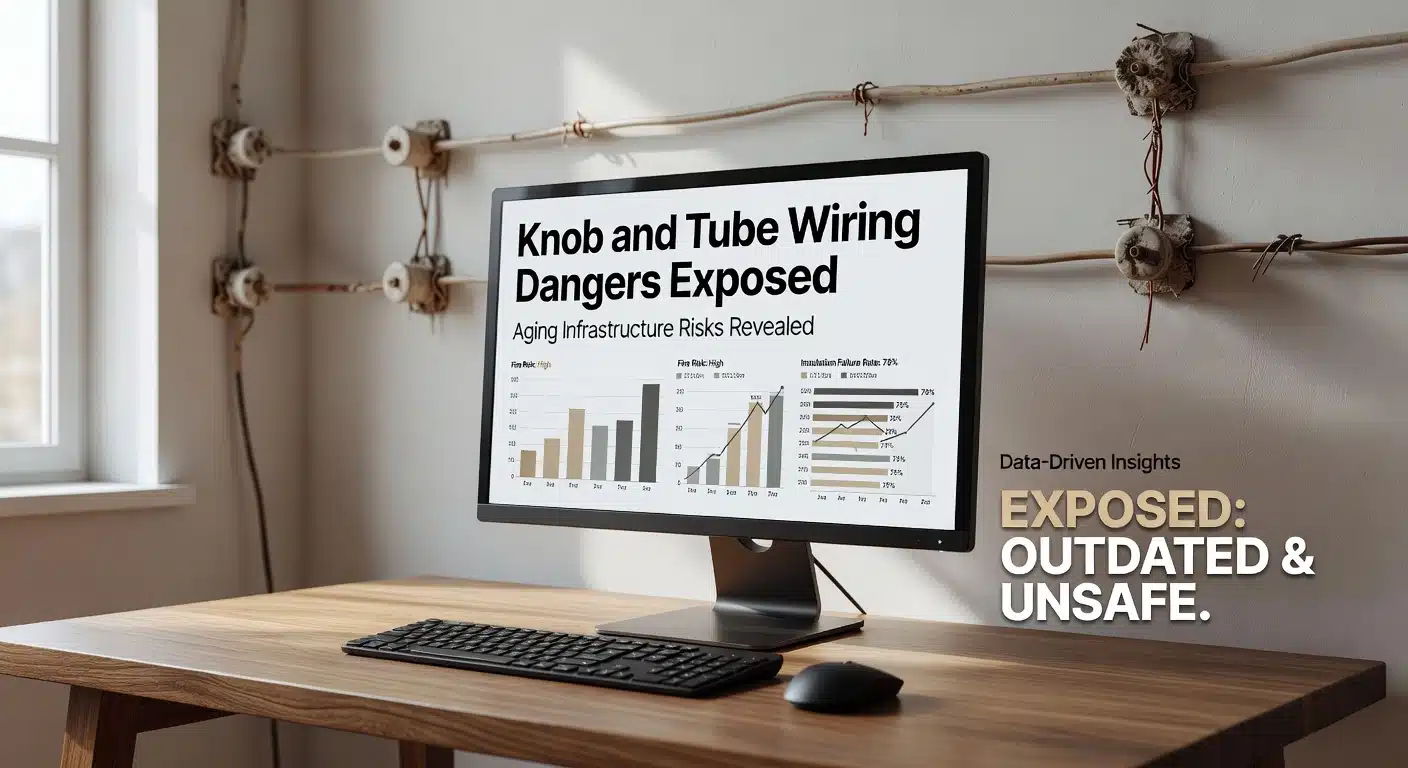
Knob and tube was the standard residential wiring method in the United States from roughly the 1880s through the 1940s. The name comes from the porcelain knobs that anchor wires as they run along or through framing, and the porcelain tubes that protect wires where they pass through joists and studs. Instead of the sheathed cable used in every home built in the last several decades, knob and tube uses two individual conductors — hot and neutral — run separately, spaced apart, with only rubber-and-cloth insulation and open air between them and anything they might touch.
It wasn’t bad wiring for its time. It was actually a reasonably clever system for the electrical loads homes carried a century ago — a few lights, maybe a radio, nothing like the dozens of devices, appliances, and chargers a modern household runs at once.
Why It’s Considered a Problem Today
The issues aren’t really about the wire itself — copper doesn’t expire. The issues are everything around it:
No grounding conductor
Knob and tube circuits are two-wire systems with no ground path. That means anything you plug into an outlet on that circuit has no safe route for a fault current to travel, which is exactly what a ground wire is there to provide. It’s also why you’ll often find ungrounded two-prong outlets in older homes, or three-prong outlets that were swapped in without ever adding real grounding behind them — which is its own hazard, since it looks safe without actually being safe.
Insulation that hasn’t aged well
The rubber-and-cloth insulation on knob and tube conductors was never meant to last a century. Over decades of heat cycling, it dries out, cracks, and can flake off entirely, leaving bare conductor exposed in places nobody’s looking.
It was never designed to be insulated over
Knob and tube relies on open air around the conductors to dissipate heat. Modern energy-efficiency work — blown-in attic insulation, spray foam, even dense-pack cellulose — can bury those wires and trap heat that the system was never built to handle. A lot of homes with knob and tube actually had it made more dangerous by a well-intentioned insulation upgrade years later, not by the wiring itself changing at all.
Decades of DIY modifications
Old wiring has usually been touched by more than one person over its lifetime — some of them licensed, some not. Splices done without a junction box, wire spliced directly to newer cable with electrical tape instead of a proper connector, and extensions run to feed a garage or addition that the original system was never sized for are all common finds.
The Insurance Problem
This is often what actually forces the issue. A lot of insurance carriers have gotten cautious about homes with active knob and tube wiring — some will decline new policies outright, others will require an inspection or a wiring update as a condition of coverage, and some will only insure it with a rider or higher premium. Policies vary a lot by carrier and by state, so if you’re buying, selling, or renewing coverage on an older home, it’s worth asking your insurer directly what their current stance is rather than assuming either way.
How to Tell If You Have It
A few common signs, if you want to check without opening up walls:
- Your home was built before roughly 1950 and hasn’t had a full electrical update since.
- You have ungrounded two-prong outlets in older parts of the house.
- You can see ceramic knobs or tubes in an unfinished attic or basement where wiring is exposed.
- Your electrical panel is older, has a lower amperage rating (60-100A rather than the 150-200A common today), or uses fuses instead of breakers.
None of these confirm it on their own, and a lot of older homes have a mix — some knob and tube still live, some already replaced by a previous owner. The only way to know for certain what’s actually behind your walls is to have a licensed electrician take a look.
What To Do About It
This isn’t a project for a confident DIYer, even an experienced one. Working safely around old, unshielded conductors — especially ones that may already be brittle — takes training most homeowners don’t have, and getting it wrong can mean a fire risk that wasn’t there before you started. This is licensed-electrician work, full stop.
The usual path is a whole- or partial-home rewire: removing the old knob and tube circuits and replacing them with modern grounded cable, updated to handle what a real 2026 household actually draws — HVAC equipment, EV chargers, kitchens full of appliances, home offices, all of it. Depending on the home, that can sometimes be done in stages rather than all at once, which is worth discussing if budget or timing is a concern.
Frequently Asked Questions
Is knob and tube wiring illegal?
No, it’s not illegal to have in an existing home, but modern electrical code doesn’t allow new knob and tube installations, and inspectors and insurers both tend to flag it when they find it.
Can I get homeowner’s insurance with knob and tube wiring?
It depends entirely on the carrier — some decline outright, some require an update or add a rider, and some don’t mind at all. It’s worth asking your insurer directly rather than assuming either way.
Do I have to replace all the wiring, or just part of it?
It depends on your home. Some homes need a full rewire, others can be addressed in stages. A licensed electrician can evaluate what’s actually there and lay out realistic options.
We’ve been doing exactly this kind of work in Seattle, Bellevue, Bothell, and the rest of the Snohomish and King County area since 1998 — Mauro Electric is licensed (WA electrical license MAUROEI971BA), bonded, and insured, with a 4.9-star rating across 200+ Google reviews. If you’re not sure what’s behind your walls, or you already know and want it handled properly, reach out about knob and tube replacement or contact us directly at (360) 653-5300 — we’ll take a real look and give you a straight answer, not a scare tactic.