If your Greater Seattle home was built between the 1950s and 1980s, there’s a real chance it has an electrical panel that inspectors and insurers have flagged as a serious safety concern. Federal Pacific Electric (FPE) panels were installed as standard equipment in millions of American homes during that era, and decades of research into how they actually perform has raised real red flags. Here’s what you need to know: how to identify one, what the evidence actually shows, and what it means for your insurance and any future home sale.
What Is a Federal Pacific Electric Panel, and Why It Matters
Federal Pacific Electric was a major electrical equipment manufacturer from the 1950s through the 1980s. The specific component at the center of the safety concern isn’t the panel enclosure itself, but the Stab-Lok circuit breaker FPE installed inside it — recognizable by the orange breaker handles and a distinctive red stripe across the face.
A circuit breaker’s core job is to trip and cut power when a circuit overloads or shorts. Engineer Jesse Aronstein spent over 20 years testing Stab-Lok breakers and, along with testing connected to the U.S. Consumer Product Safety Commission (CPSC), found failure-to-trip rates ranging from roughly 14% to more than 70% depending on breaker type and conditions, with a commonly cited figure of around 1 in 4 breakers failing to do their most basic job. When a breaker doesn’t trip, an overloaded circuit keeps carrying current and the wiring inside your walls can overheat silently, with no smell or alarm until real damage has already been done.
No federal recall has ever been issued for these panels. The CPSC investigated FPE breakers and found them defective, but closed its review in 1983 without ordering a recall, citing limited resources — not a finding that the panels were safe. Millions remain in service today.
How to Identify a Stab-Lok Panel in Your Home
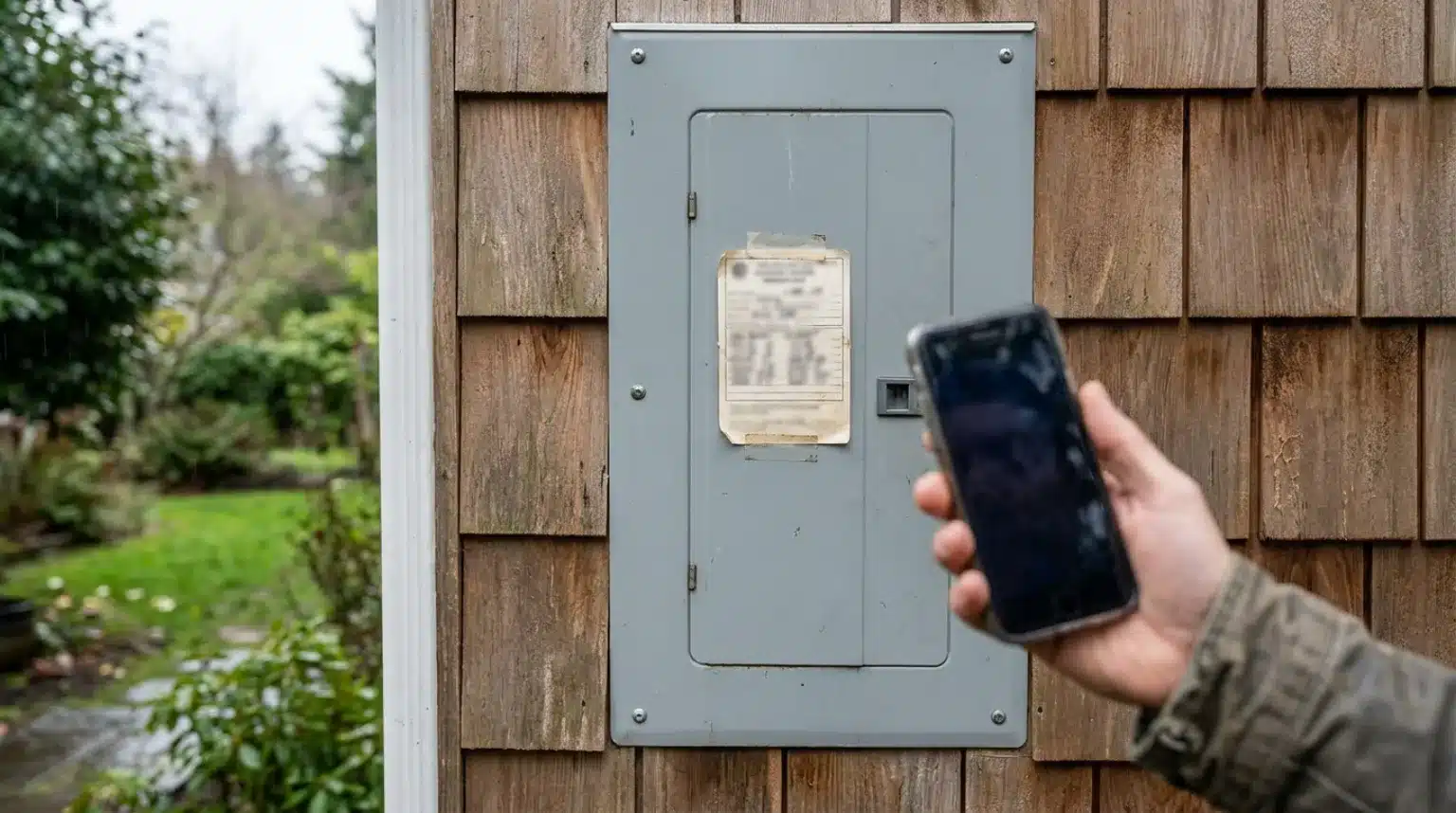
Your main panel is usually in the basement, a utility room, the garage, or a hallway closet. It’s safe to open the outer panel door and look at the interior label and the breaker faces — do not remove the inner deadfront cover, which exposes live components even when breakers are switched off.
Look for “Federal Pacific Electric” or “Stab-Lok” printed on the label or embossed on the breaker handles, and the distinctive red stripe across the breaker handles — the clearest visual tell, unique to Stab-Lok and not found on modern panels. If labeling has faded, home age is a useful secondary clue: homes built or last rewired between 1955 and 1985 that have never had a panel replacement have a real chance of having one, and this describes a meaningful share of housing stock throughout Bothell, Kenmore, Kirkland, and the rest of Greater Seattle.
If you spot the markers, take photos of the panel label and breaker faces and share them with a licensed electrician before scheduling an in-person assessment.
Is the Danger Real? What the Evidence Shows
The short answer, backed by decades of independent research and a federal investigation, is yes.
Some homeowners assume that because FPE panels were never formally recalled, they must have been cleared. That’s a misreading of the record — the CPSC found the breakers defective and closed the case for resource reasons, not safety ones.
There’s also a common point of confusion around UL listing: the Stab-Lok breakers lost their UL listing, while the panel enclosures technically didn’t. That distinction matters less than it sounds, since the breakers are the safety-critical part. FPE’s parent company also acknowledged in a 1982 SEC filing that UL approval had been obtained through deceptive practices, and a 2002 New Jersey court ruling found FPE knowingly distributed breakers that didn’t meet the UL standard on their own labels.
To be fair: not every FPE panel in service will cause a fire. Many homeowners have lived with one for decades without incident — not because the panel is safe, but because the specific overcurrent event that would expose the defect hasn’t happened yet. The risk is cumulative and probabilistic, which is exactly why electricians and home inspectors consistently flag these panels as a replacement priority.
What It Means for Insurance and a Home Sale in Washington
The financial stakes extend beyond fire risk. Insurers are increasingly cautious about FPE panels specifically, with some carriers publishing underwriting guidance that flags Stab-Lok panels as a known coverage concern. If you have one, the most useful step is to contact your insurer directly, name the panel by its full name, and get their answer on coverage in writing rather than relying on a verbal assurance.
On the real estate side, FPE panels are a well-recognized red flag to buyers, buyer’s agents, and lenders in the Greater Seattle market, and replacement is increasingly requested as a condition of closing. Sellers with an FPE panel are often negotiating from a weaker position. Permitted, inspected replacement work creates a documented record that matters in both conversations — an insurer sees confirmed remediation, a buyer’s agent sees a transferable record of code-compliant work, and unpermitted work offers neither protection.
Planning an EV Charger? Your FPE Panel May Need to Go First
A Level 2 home EV charger needs a dedicated 50-amp circuit, and most older FPE panels are already running close to their original capacity after decades of added appliances and HVAC load. Adding a sustained high-draw circuit on top of that, on breakers already documented to fail to trip under overload, is exactly the scenario Stab-Lok breakers handle worst — and it typically won’t pass inspection. Many Greater Seattle homeowners discover this mid-project, during the pre-installation assessment. The upside: a panel replacement and EV charger installation handled as one permitted project is usually more efficient than scheduling them separately.
What Replacement Actually Involves
The first step is always a professional inspection, not a signed contract. Your electrician will assess the panel and breaker condition, wiring age and type, grounding, and overall load. Aluminum branch wiring and other issues from the same era often surface once the cover comes off, which is why a firm quote only comes after an on-site look.
A typical replacement removes the old panel, installs a new one (most commonly upgraded to 200-amp service, even from a 100-amp original, to leave headroom for EV chargers, heat pumps, and future circuits), transfers circuits to new breakers, updates grounding to current code, and is filed for permit with your local jurisdiction, including coordinating a temporary utility disconnect. In Greater Seattle, a straightforward replacement typically takes one to two days and runs roughly $2,000–$4,500, with the range driven by panel size, accessibility, and whether additional wiring work turns up during inspection.
Other Legacy Panels Worth Knowing About
FPE dominates this conversation, but it isn’t the only legacy panel with a documented risk profile in homes of this era:
Zinsco (also sold as GTE-Sylvania) panels use an aluminum bus bar and breaker design prone to arcing, and breakers can fuse to the bus bar, making them impossible to shut off during a fault — a similar failure-to-trip problem to FPE, common in 1960s-70s housing stock.
Challenger panels, from the late 1980s and early 1990s, have also been associated with breaker failure and overheating.
Bulldog Pushmatic panels use a push-button design with parts that are no longer manufactured, making ongoing code compliance harder over time even without the same failure-to-trip profile.
If any of these show up during an inspection or transaction, the process is the same as for FPE: get a professional assessment before making a decision.
The Bottom Line
If your home was built before 1985 and the panel has never been replaced, the most useful thing you can do is schedule an inspection. Knowing what you have costs a fraction of what a fire, a denied insurance claim, or a stalled home sale would.
Mauro Electric has served Greater Seattle homeowners since 1998 and has replaced legacy panels throughout the area with permits and inspections on record. Contact us for an assessment, or call 360-653-5300.