Western Washington didn’t used to think much about wildfire smoke. That’s changed. Late summer and early fall now regularly bring stretches where the Puget Sound Clean Air Agency flags air quality as unhealthy across the region — including a multi-day smoke event across Seattle and the surrounding area this past August. For homeowners, the real question isn’t whether smoke season will happen again. It’s what to actually do about the air inside your own house while it does.
The good news: you don’t need to guess. The EPA publishes specific guidance on this, and most of it comes down to a few decisions about your HVAC system and, if you don’t have one, your filtration options.
What Filter Rating Actually Helps
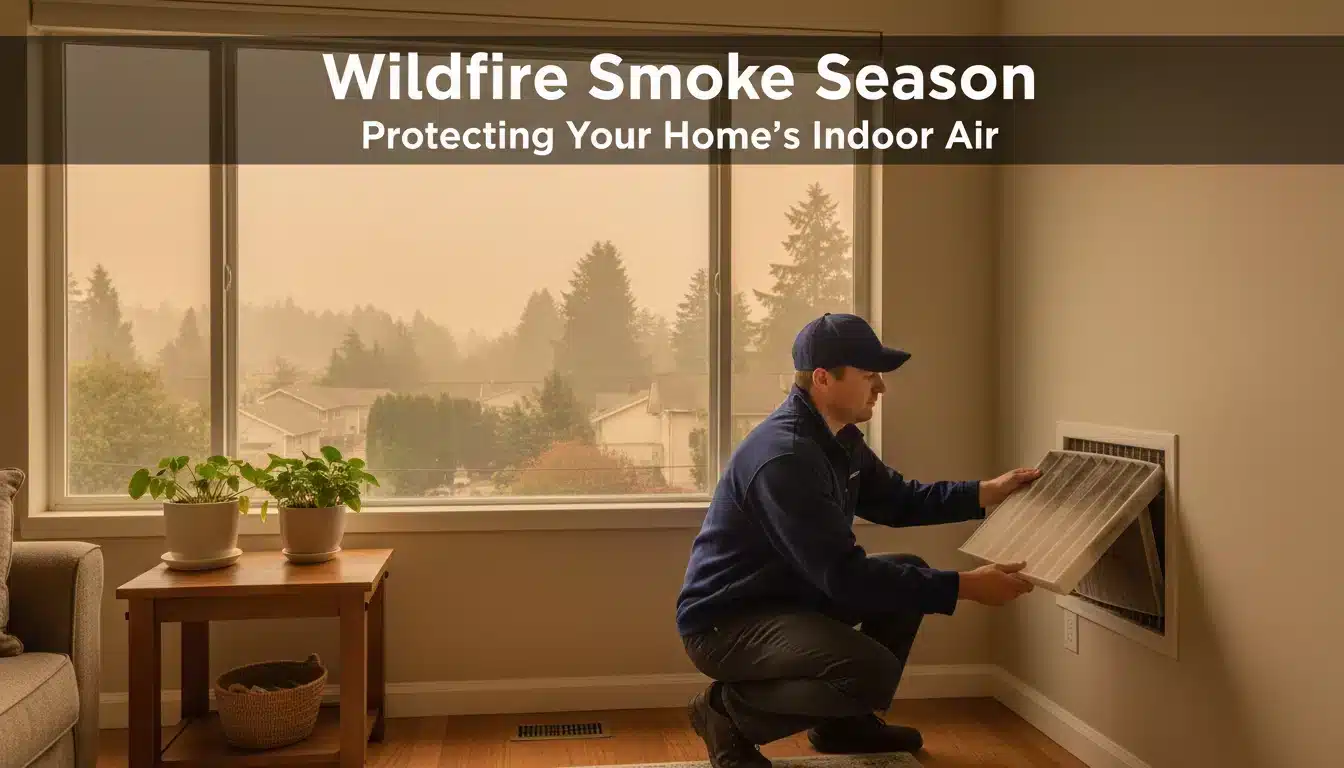
If your home has central heating or cooling, the filter matters more than most homeowners realize. The EPA specifically recommends using a MERV 13 filter, or as high a rating as your system can handle, during smoke events. MERV 13 is rated to capture the kind of fine particulate that makes wildfire smoke harmful to breathe — the same particles that pass right through a standard MERV 8 filter most systems ship with.
One caution worth taking seriously: not every system is built to handle a MERV 13 filter. A rating that’s too high for your blower can restrict airflow and force the motor to work harder than it’s designed to. Before you swap filters, it’s worth having an HVAC professional confirm your system can actually support the upgrade — that’s a five-minute check that can save you a service call later.
The HVAC Settings That Matter During a Smoke Event
Beyond the filter itself, the EPA’s guidance covers two settings worth knowing:
- Close the fresh air intake. If your system has one (sometimes labeled “recirculate mode”), closing it keeps the system from actively pulling smoky outdoor air inside.
- Run the fan continuously. Rather than only running when heating or cooling kicks on, setting the fan to run continuously keeps air moving through the filter, capturing more fine particles over time.
Both are settings you can change yourself on most thermostats — no service call required. If you’re not sure your system has these options, that’s worth asking about during your next maintenance visit.
What If You Don’t Have Central Air?
This is where a lot of older Seattle-area homes run into a real gap. Homes built before central air conditioning became common — a large share of the housing stock in neighborhoods across Seattle, Bellevue, and the rest of the Eastside — often don’t have the ductwork these HVAC settings depend on.
The EPA’s fallback recommendation is a portable air cleaner, sized appropriately for the room and chosen specifically for one that produces little to no ozone (ozone itself is a lung irritant, so it defeats the purpose). For a home that’s dealing with smoke season year after year without any path to whole-home filtration, that’s often where the conversation naturally turns to a ductless mini-split system — it adds both heating and cooling capacity to a home that never had it, without requiring ductwork to be added throughout the house.