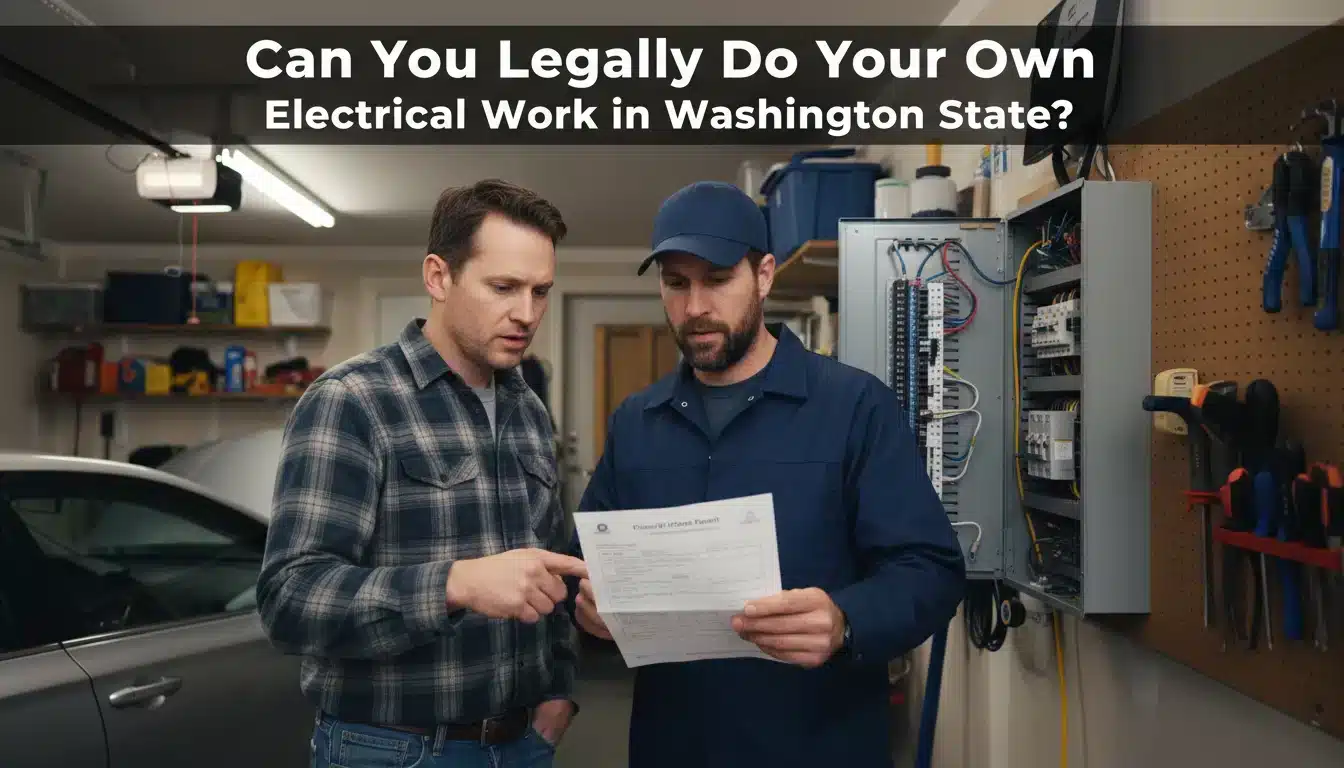
Washington State does allow homeowners to do some of their own electrical work without hiring a licensed electrician. That surprises a lot of people — and it leads to an even more common follow-up question: does that mean it’s a good idea? Those are two very different questions, and mixing them up is where homeowners tend to get into trouble.
Here’s what the law actually allows, what it doesn’t change, and why “legal” and “advisable” aren’t the same thing when you’re working inside your own walls.
The Homeowner Exemption, in Plain Terms
Washington’s electrical licensing law — RCW 19.28.261 — includes an exemption that lets a property owner perform electrical work on their own home without holding an electrical license, under a specific set of conditions:
- The property has to be your primary residence — one you both own and actually live in.
- It doesn’t apply to rental property, a business you own, or a home you’re preparing to sell or flip within the next year.
- A friend, neighbor, or relative can help you, as long as none of you are doing the work as a paid trade or business.
That’s the exemption. It’s narrower than most people assume, and it’s easy to misread it as “homeowners can do their own electrical work, full stop.” It doesn’t say that.
What the Exemption Does NOT Change
This is the part that trips people up: the homeowner exemption only waives the requirement that the person doing the work hold an electrical license. It does not waive the permit and inspection requirements that apply to most electrical work regardless of who performs it.
In practice, that means if you do qualifying work yourself, you’re still expected to pull the appropriate permit and have the work inspected before it’s considered complete and legal. Skipping that step doesn’t make the work “under the radar and fine” — it makes it unpermitted work, which carries its own set of problems whether you hired someone or did it yourself.
We’ve written separately about what a permit inspection actually looks like if you want the full picture of that process — it’s the same inspection standard whether a licensed contractor did the work or you did.
Why the Exemption Exists — and Why It’s Not an Endorsement
The homeowner exemption isn’t Washington State vouching for DIY electrical work. It exists because property owners have always had some legal latitude to work on their own homes, and the state drew a line that respects that while still protecting everyone else: tenants, future buyers, and neighbors who could be affected if something goes wrong. That’s also exactly where the exemption stops. The moment work happens on a rental, a property you’re about to sell, or anything beyond your own primary residence, the exemption disappears and licensing requirements apply in full.
Where This Gets Genuinely Risky
Electrical work has a wide range, and not all of it carries the same stakes. Something like replacing a light fixture with a comparable one is a very different undertaking than working inside a panel, running new circuits, or tying into a service entrance. The legal exemption doesn’t distinguish between “low-risk” and “high-stakes” electrical work — but your actual risk absolutely does. The consequences of a mistake in a panel or in wiring you can’t see once the wall is closed up aren’t just inconvenient. They’re the kind of thing that shows up as a fire hazard years later, or as a problem a home inspector flags right when you’re trying to sell.
The Insurance and Resale Problem
Unpermitted electrical work — whether it was done by you or by an unlicensed handyman you hired — can become a real liability at two specific moments: when something goes wrong and you file an insurance claim, and when you try to sell the house. Insurers can and do investigate the cause of an electrical fire or damage claim. If the work involved turns out to be unpermitted, that can affect how a claim gets handled. And when you sell, a home inspector or a buyer’s own contractor can spot signs of electrical work that was never permitted or inspected — which turns into a negotiation problem (or a deal-breaker) at exactly the wrong time. A permit and a passed inspection aren’t just paperwork. They’re the record that proves the work was actually checked by someone independent of whoever did it.
This Is Different From Hiring an Unlicensed Handyman
One more distinction worth being clear about: the homeowner exemption applies to you doing your own work on your own primary residence. It does not extend to hiring an unlicensed person to do electrical work for you — that’s illegal in Washington regardless of the homeowner exemption, full stop. If you’re paying someone to do electrical work in your home, that person needs to be a licensed electrical contractor. It’s worth knowing how to check an electrician’s license in WA State before anyone starts work, precisely because “the homeowner exemption” gets misapplied by contractors who aren’t actually licensed and are hoping you won’t ask.
When It Makes Sense to Just Call a Licensed Electrician
For most electrical work beyond the simplest fixture swap, calling a licensed electrical contractor ends up being the more practical choice anyway — not just the safer one. A licensed electrician pulls the permit, schedules the inspection, and stands behind the work, which removes the risk of a mistake becoming your problem alone later. If you’re weighing whether a project is something you’re legally allowed to attempt versus something you actually want to take on yourself, that’s usually the real question worth asking a professional directly.
Serving Snohomish and King County
Mauro Electric is a licensed electrical and HVAC contractor serving Snohomish and King County, including Bothell, Seattle, Bellevue, Kirkland, Everett, Lynnwood, Mercer Island, Issaquah, Snoqualmie, Mukilteo, and Edmonds. Whether you’re deciding if a project is something to take on yourself or ready to bring in a licensed pro, we’re happy to talk through what a job actually involves before you start.