Imagine the frustration of a sudden power outage plunging your home into darkness. The fridge hums to a stop, your lights flicker out, and essential appliances fall silent just when you need them most. Storms, grid failures, or unexpected blackouts can disrupt daily life, leaving families vulnerable without heat, refrigeration, or even security systems. What if you could eliminate that worry forever?
Enter the whole house standby generator installation, your reliable safeguard against power disruptions. This comprehensive guide walks beginners through every step of selecting, installing, and maintaining a standby generator that powers your entire home automatically. As experts in home backup systems, we deliver clear, precise instructions tailored for those new to the process.
You will learn how to assess your power needs, choose the right generator size, prepare your site safely, handle electrical connections with professional standards, and test your system for flawless operation. We cover permits, tools, common pitfalls, and cost-saving tips to ensure a smooth installation. By the end, you will have the confidence to tackle this project or oversee contractors effectively, securing uninterrupted power for your household.
Benefits of Whole House Standby Generators for Seattle Homes
Seamless Automatic Startup During Seattle Storms
Living in the Greater Seattle area means dealing with frequent power outages from intense winter storms and atmospheric rivers, which dumped heavy rain and wind across Snohomish and King counties in December 2025, leaving over 310,000 Puget Sound Energy customers in the dark. A whole house standby generator detects these outages instantly through its automatic transfer switch and starts up within 10-15 seconds, restoring full power to your home before discomfort sets in. This hands-free operation eliminates the need for manual intervention, unlike portable units that require fueling and setup in the rain. Local homeowners benefit from this reliability during events like the 2025 floods that knocked out power for days in Skagit and Island counties. Professional installation ensures compliance with Seattle’s seismic codes and fuel line setups for natural gas or propane. See recent Seattle outage impacts.
Protecting Your Home’s Essentials
Standby generators safeguard HVAC systems, appliances, and electronics from surges that occur when power flickers back on, preventing costly damage to refrigerators, freezers, and smart devices. They keep your heating running in damp Seattle winters, avoiding frozen pipes or mold growth during multi-day blackouts common in atmospheric river events. Food spoilage alone can cost families $100 to $500 per outage, but these systems maintain steady power to preserve perishables and ensure comfort. Well pumps and medical equipment stay operational, critical for rural homes in Snohomish County. Built-in surge protection delivers clean electricity, outperforming grid power in stability. This protection translates to long-term savings and reliability for beginners investing in home backup.
Boosting Resale Value by 3-5%
Industry data from real estate experts shows professionally installed whole house standby generators increase home resale value by 3-5%, adding $12,000 to $25,000 to a typical $400,000-$500,000 Seattle property. Appraisers in the Pacific Northwest value this feature highly due to buyer demand in outage-prone areas. Post-2025 storm recovery highlighted its appeal, with ROI often surpassing 150% through lower insurance premiums. For Greater Seattle sellers, this upgrade stands out on listings, backed by Consumer Reports analysis.
Market Growth and Peace of Mind
The US home standby genset market will exceed $3.3 billion in 2025, growing at a 7.9% CAGR through 2035, driven by climate trends like Seattle’s worsening storms. Homeowners in Snohomish, King, Island, and Skagit counties gain unmatched peace of mind, powering security systems and sump pumps during extended outages. Mauro Electric Inc., serving Bothell and Greater Seattle since 1998, delivers efficient, on-time installations for this rising demand. Weekly self-tests ensure readiness, providing confidence year-round. Learn why whole home generators are essential. This investment protects your lifestyle seamlessly.
How to Size Your Generator for Optimal Performance
Sizing your whole house standby generator correctly ensures reliable power during Seattle’s frequent storms, preventing overloads that can trip breakers or damage equipment. For beginners, start by listing essential loads in your 2000-3000 sq ft home, such as lights (600-2000 running watts total), refrigerator (600-700 running watts, 1200-2200 starting), HVAC systems like gas furnace blowers (600-800 running, 1200-2400 starting), and medical devices (300-500 running watts). These typically total 8,000-12,000 running watts, with peaks up to 20,000-25,000 watts, fitting a 10-25 kW unit. Undersizing leads to failures; for example, a fridge starting surge alone can overload a mismatched generator. Add a 20-25% buffer for safety.
Follow these steps for precise sizing:
- Inventory appliances and calculate loads: Review your utility bills for peak kWh usage over 12 months. List running watts (continuous power) versus starting watts (2-3x higher for motors). Prioritize essentials; stagger startups to manage peaks, like delaying HVAC after lights and fridge.
- Use free tools or consult experts: Input data into the Generac Solution Finder for instant recommendations. Avoid guesswork, as undersizing causes 30-40% of service calls and overload risks like overheating. Contact professionals like Mauro Electric Inc., certified Generac installers in Bothell, for a free site audit compliant with Seattle codes.
- Select Seattle-suited models: Opt for Generac 18-22 kW Guardian Series (e.g., 7228 or 7043), ideal for natural gas or propane in Puget Sound homes. These handle whole-house needs, including HVAC, with WiFi monitoring.
- Plan for expansions: Add 10-15 kW buffer for EV chargers (7-12 kW draw). Mauro Electric integrates scalable wiring for future-proof installs.
This approach guarantees optimal performance; pros complete sizing during your efficient, on-time installation. (248 words)
Selecting the Right Standby Generator Model
Step 1: Compare Natural Gas Versus Propane Fueled Units
Begin your selection by evaluating fuel options for uninterrupted power during Seattle’s prolonged outages. Natural gas units connect to your home’s utility line, offering continuous supply without refueling as long as the infrastructure holds, which suits most urban Greater Seattle homes with reliable lines. They cost 20-50% less per BTU long-term and eliminate tank maintenance, though power output derates by 10-20% due to lower energy density. Propane units, fueled by on-site 500-1,000 gallon tanks, deliver full rated power and store indefinitely, providing independence if gas lines fail, but require refills that average 2.2 gallons per hour at half-load on a 22kW model. In Washington winters, propane avoids freezing risks better. Choose natural gas for convenience if available; opt for propane for redundancy. For detailed pros and cons, see this natural gas vs propane comparison.
Step 2: Evaluate Generac Models for Reliability
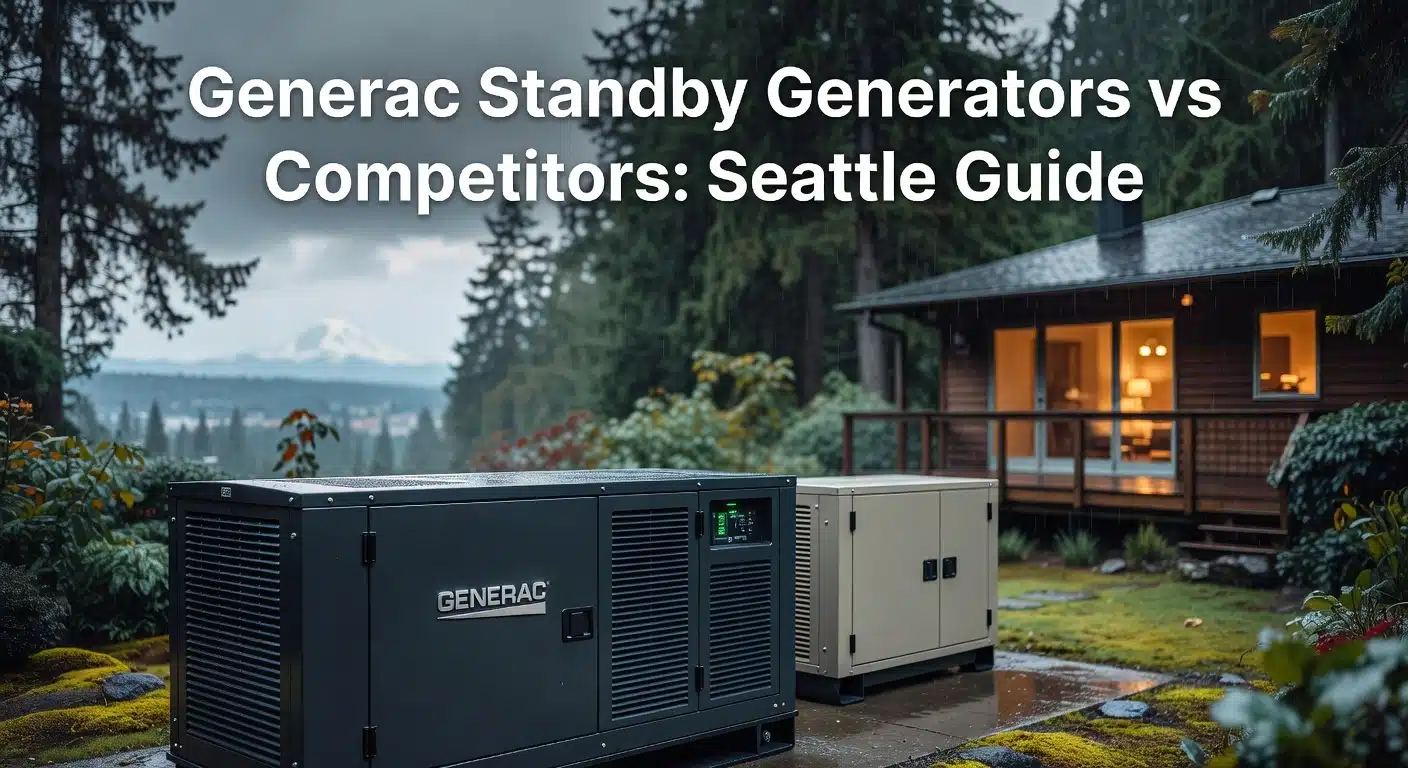
Next, focus on Generac Guardian Series, leaders in residential reliability with 4.8/5 star ratings and 5-year warranties. For 2,000-3,000 sq ft homes, consider the 22kW model (7043) at $6,100, powering HVAC and appliances with WiFi monitoring; the 24kW at $6,600 handles heavier loads; or the 26kW (7291) at $7,000 for whole-house coverage. These air-cooled units start in 10 seconds, backed by 300,000-hour engine tests. Use Generac’s online load calculator to match your needs precisely.
Step 3: Review Trending Features
Prioritize smart integration like Generac’s Mobile Link app for remote monitoring, runtime alerts, and Quiet-Test self-checks, standard on 2026 models. Dual-fuel options, configurable for natural gas or propane at install, offer flexibility amid rising outages, with the U.S. market hitting $3.6B in 2026.
Step 4: Verify Seismic Compliance
Washington’s Seismic Design Category D/E requires ASCE 7 bracing and certified mounts; Generac complies with add-on kits for safe installation.
Step 5: Select Certified Installers
Choose Generac-authorized dealers like Mauro Electric Inc., experienced since 1998, to validate warranties and ensure code-compliant whole house standby generator installation. Their expertise guarantees efficiency and on-time service for Bothell and Greater Seattle homes. Contact them for a custom assessment.
Securing Permits and Complying with Local Codes
Before diving into your whole house standby generator installation, securing permits and complying with local codes is essential for safety, legality, and warranty validity in Bothell and Greater Seattle. Start by contacting the Bothell Permit Center via MyBuildingPermit.com or Seattle’s Department of Construction and Inspections (SDCI) at least 4-6 weeks early. These departments, along with the Washington State Department of Labor & Industries (L&I) for electrical permits detailed here, require approvals for electrical, mechanical, and sometimes building permits costing $50-$300 each.
Follow these steps for compliance:
- Gather and submit documentation: Prepare generator specs (e.g., 18-22 kW model, UL 2200 listing, natural gas or propane fuel type), a site plan showing 5-10 ft setbacks from windows and doors, one-line electrical diagrams, load calculations, and fuel source details like Puget Sound Energy (PSE) meter upgrades.
- Adhere to NEC 2023 and seismic codes: Ensure equipment meets National Electrical Code Article 702 for automatic transfer switches and grounding. In Seismic Design Category D areas like Bothell, use certified seismic bracing and vibration isolators per Washington State Building Code (IBC 2021) to withstand Puget Sound earthquakes.
- Schedule inspections: Budget 3-7 days post-installation for rough-in (wiring) and final checks before energizing; L&I/SDCI must approve to avoid fines or delays.
- Hire local experts like Mauro Electric Inc.: Our licensed team, serving Bothell since 1998, handles L&I filings, code navigation, and coordination to complete your 1-3 day installation efficiently and on time, minimizing downtime during Seattle storms.
This process ensures reliable, code-compliant power, transitioning seamlessly to professional setup.
Preparing the Installation Site
Selecting a Level Outdoor Location
Begin by choosing a level outdoor spot on stable ground, elevated above potential flood zones common in the Seattle area. Local codes, including NFPA 37 adopted in Bothell and Greater Seattle, mandate at least 5 feet from operable windows, doors, vents, or other building openings to safely direct exhaust fumes away from living spaces. Maintain 18 inches from walls, 3 feet from combustibles like fences or shrubs, and 18-36 inches on sides and rear for service access. Grade the site with a minimum 2% slope to divert rainwater, preventing erosion. This setup ensures optimal airflow and compliance, avoiding warranty issues or fines.
Pouring a Reinforced Concrete Pad
Excavate 4-6 inches deep, removing vegetation and adding 4 inches of compacted gravel for drainage. Form a pad sized to your generator’s footprint plus 6-12 inches on all sides, using 4-6 inch thick reinforced concrete with #4 rebar on 12-18 inch centers for seismic stability in Seattle’s terrain. Aim for 3,000-4,000 PSI mix; pour, level to within 1/8 inch, and cure under moist conditions for 7 days minimum. This foundation supports 10-25 kW units reliably.
Ensuring Ventilation, Exhaust, and Accessibility
Position the unit so exhaust points away from living areas, HVAC intakes, and neighbors, with unobstructed intake at the base. Provide 3 feet of front working space and rear clearance for maintenance like oil changes.
Verifying Seattle Soil Stability
Test soil bearing capacity (minimum 2,000 PSF) via geotechnical analysis, addressing clay expansion and liquefaction risks from Puget Sound quakes and heavy rains.
Coordinating with Mauro Electric Professionals
Partner with Mauro Electric Inc., your trusted Bothell electricians since 1998, for precise measurements, permits, and on-time pad curing (28 days full strength). Our team handles everything efficiently, delivering seamless whole house standby generator installation. US home standby gensets market growth underscores rising demand for such prep in outage-prone areas.
Mounting the Generator Unit
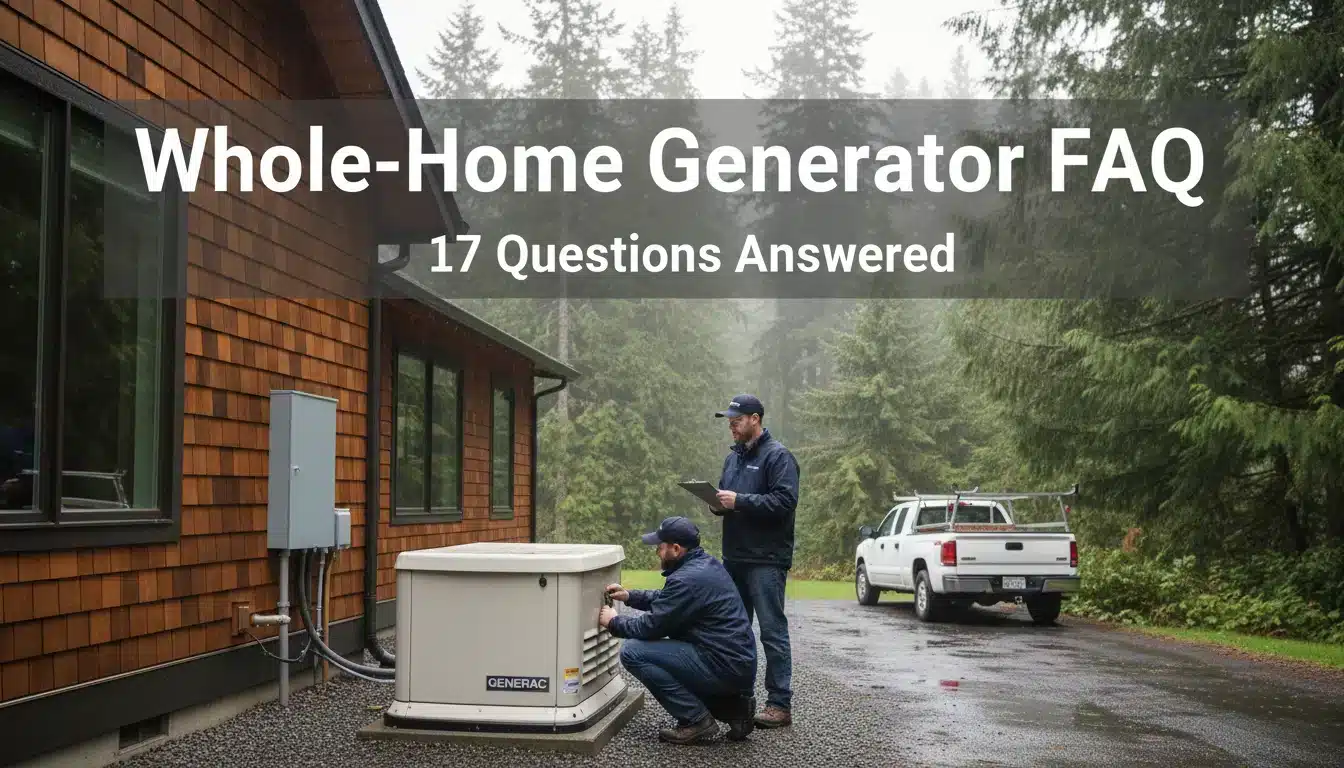
Position the generator on the prepared concrete pad using the manufacturer’s template to mark anchor bolt holes. Secure it firmly with 3/8- to 5/8-inch diameter expansion anchor bolts, embedding them 3-4 inches deep and torquing to 20-40 ft-lbs for stability against winds up to 150 mph and seismic activity common in Washington. For details, refer to Generac mounting requirements. Install 1/2- to 1-inch thick rubber vibration pads beneath the base before anchoring; these reduce structure-borne noise by 5-15 dB, keeping levels below 65 dB to comply with residential ordinances in Bothell neighborhoods.
Next, connect the exhaust system using Schedule 40 black iron pipe, sloping horizontal runs 1/4-1/2 inch per foot away from the engine for condensate drainage, and add water traps at low points. Ensure proper grounding per NEC Article 250 by bonding the frame to the equipment grounding conductor, avoiding double-bonding to prevent shocks. Finally, perform alignment checks with a laser level, shimming if off by more than 1/8 inch, and verify clearances before electrical or fuel connections. At Mauro Electric Inc., our experts complete this phase efficiently and on time for seamless whole house standby generator installation. Follow Holmes-approved installation steps for best results.
Setting Up Fuel Lines and Supply
Once the generator is securely mounted on its concrete pad, the next critical step in whole house standby generator installation is setting up the fuel lines and supply. Begin by running dedicated gas or propane lines from your utility meter or propane tank to the unit. Hire licensed plumbers or gas technicians, as required by Seattle codes and NFPA 54/58 standards, to ensure proper sizing (e.g., black iron pipes for minimal pressure drop) and burial to avoid hazards. Coordinate with Puget Sound Energy (PSE) to confirm meter capacity for natural gas setups common in Greater Seattle homes.
Install compliant shutoff valves (full-port ball valves with solenoid options) and regulators upstream of flexible hoses, adhering to local fuel codes and seismic requirements in Bothell. Pressure test the entire system before final connections: pressurize to 1.5x operating pressure (e.g., 5-10 psi), hold for 10-15 minutes using a manometer, and check for leaks with soapy solution—no drop exceeding 2 inches water column. Key NFPA standards for generators.
Opt for natural gas in connected Seattle homes for unlimited runtime during prolonged storms, eliminating refueling needs. For 2026 flexibility, consider rising dual-fuel trends (8.4% CAGR), allowing seamless switches to propane amid grid disruptions. At Mauro Electric Inc., our certified team completes this efficiently and on time, ensuring code-compliant, leak-free operation for reliable backup power. Gas line installation guide.
Installing the Automatic Transfer Switch
Mount the automatic transfer switch (ATS) indoors near your main electrical panel in a garage or utility room to minimize voltage drop and wiring costs. Secure the NEMA 3R-rated enclosure vertically to a rigid wall with heavy-duty fasteners, ensuring 36 inches of front clearance per NEC standards. This placement complies with Bothell codes and allows easy maintenance.
Size the ATS to match your generator’s kW rating for full home coverage; for an 18-22 kW unit serving 2,000-3,000 sq ft Seattle homes, choose a 100-200 amp model (amps = kW x 1,000 / 240V, plus 25% margin for inrush). Professional sizing prevents overloads during storms.
Wire the ATS to sense outages via dedicated terminals, signaling the generator to start and transfer loads automatically within 10 seconds using break-before-make action. Connect utility lines to upper lugs, generator to lower, and loads to output; torque precisely with 75°C wire.
Integrate seamlessly with your breaker box by rerouting critical circuits through conduit, avoiding backfeed risks. At Mauro Electric Inc., we handle permits and load calcs efficiently.
Test by pressing the ATS button or simulating outages: verify sensing, 5-10 second failover, retransfer, and voltages (230-246V). Annual pro checks ensure reliability. ATS installation guide
Connecting to Your Home Electrical Panel
With the automatic transfer switch (ATS) securely mounted near your main electrical panel, the next phase of whole house standby generator installation involves connecting it to your home’s electrical system for seamless power transfer. Our team at Mauro Electric Inc. runs heavy-gauge, 4-wire feeder cables (L1, L2, neutral, ground) such as #2/0 AWG copper or 4/0 aluminum through rigid metal or PVC conduit from the generator output to the ATS terminals. This minimizes voltage drop over distances up to 50 feet while complying with NEC requirements for 75°C ampacity.
For partial load management on 18-22 kW units common in 2,000-3,000 sq ft Seattle homes, prioritize critical circuits like HVAC, refrigerator, sump pump, and lights using ATS modules that shed non-essentials during overloads exceeding 20% capacity. Tighten all connections to precise NEC 110.14(D) torque specs, such as 50 in-lbs for 100A breakers or 275 in-lbs for 200A lugs, using a calibrated wrench to prevent arcing fires. Clearly label circuits (e.g., “Priority 1: Essentials”) and panels per NEC 700.7 for easy maintenance. Finally, verify phase matching with a multimeter: 120V L1-N/L2-N and 240V L1-L2 at 60 Hz to avoid motor damage. Mauro Electric ensures efficient, code-compliant work completed on time for your peace of mind.
Testing and Commissioning the System
After completing the electrical connections, testing and commissioning ensure your whole house standby generator operates flawlessly during outages. At Mauro Electric Inc., our certified technicians conduct thorough loaded run tests by simulating power failures: set the controller to AUTO, disconnect utility power at the main service breaker, and verify startup within 10-15 seconds, smooth load transfer via the automatic transfer switch, and stable operation (240V ±5%, 60Hz ±1%) under home loads like HVAC and lights for 20-30 minutes. We check battery voltage (at least 12.6V, clean terminals), oil levels between marks using manufacturer-specified grade, and coolant (50/50 mix, freeze protection to -34°F) to prevent failures, logging all per NFPA 110 guidelines.
Next, program the exercise schedule for weekly 20-30 minute self-tests to lubricate the engine and test controls automatically. Secure final inspections from Bothell authorities for code compliance (NEC, NFPA 37/110), obtaining your certificate. Mauro Electric trains you on daily checks, manual override, alarm responses (red for critical issues), and emergency protocols like clearing debris and app monitoring, delivering reliable, on-time service since 1998 for Seattle homeowners’ peace of mind.
Breaking Down Installation Costs in 2026
Generator Unit and Labor Costs
For a typical 18-22 kW whole house standby generator installation in Seattle, expect the unit itself to cost between $5,000 and $15,000. These air-cooled models, ideal for 2,000- to 3,000-square-foot homes, handle essential loads like HVAC, appliances, and lighting during outages. Labor adds $3,000 to $5,000, covering professional wiring, fuel connections, and testing, which usually takes 1-3 days. This brings the base total to $9,800-$18,500, aligning with 2026 Seattle market rates influenced by local codes and demand from frequent storms. At Mauro Electric Inc., our certified team ensures efficient, on-time completion to minimize disruptions.
Key Additional Expenses
Beyond the unit and labor, factor in permits at $500-$1,500, required for electrical, plumbing, and zoning compliance in Bothell and Greater Seattle. A vibration-resistant concrete pad runs $1,000-$2,000, essential for a stable 6×6-foot base. The automatic transfer switch adds $1,000-$2,500, enabling seamless power switching. These elements can push totals higher for complex sites, but bundling them through experts like Mauro Electric streamlines costs and avoids surprises.
Operational and Comparative Costs
Running costs are low at $2-$8 per hour, depending on fuel like natural gas or propane; a 22 kW unit at half load might use 250 cubic feet of gas hourly. Seattle labor averages $1,058-$4,145 per Angi data, lower than national figures due to competitive local pros, yet full installs match $9,800-$18,500 benchmarks. This positions Seattle favorably amid rising outage risks.
Financing for Affordability
Financing options, such as 0% APR promotions, make installations accessible with low monthly payments. Bundles combining units, switches, and pads offer 10-15% savings while boosting efficiency. Mauro Electric provides tailored quotes, resale value increases of 3-5%, and ongoing maintenance to maximize your investment. Contact us for a precise 2026 estimate tailored to your home.
Essential Maintenance for Long-Term Reliability
To ensure your whole house standby generator delivers reliable power for 20-30 years, follow these essential maintenance steps. Proper care prevents common failures like battery degradation or fuel system issues, which affect up to 99% uptime during Seattle’s frequent outages. Beginners can start with a simple checklist, building on the testing phase of installation for long-term performance.
1. Schedule Annual Services for Oil, Filters, Battery, and Belts. Arrange professional inspections once a year, or every 200 hours of operation, aligning with manufacturer guidelines. Technicians will change the oil and filter using specified synthetic types like 5W-30, inspect for contamination, and replace air and fuel filters. Check the battery voltage, electrolyte levels, and terminals every six months, replacing it every 2-3 years to counter heat and humidity. Examine belts for cracks, wear, or proper tension. These tasks, costing around $600 annually, avert overheating and extend engine life significantly.
2. Run Weekly Exercises Automatically. Activate the built-in exercise timer to run the unit for 10-20 minutes weekly under no-load conditions. This lubricates parts, circulates fluids, exercises the starter, and dissipates moisture, keeping the system primed without manual effort. Confirm the “Auto” mode is set, listen for smooth operation, and inspect afterward for leaks. Generators often run just 26 hours yearly otherwise, so this habit ensures instant startup.
3. Monitor for Corrosion in Seattle’s Wet Climate. In our rainy region with high humidity, check monthly for rust on batteries, wiring, exhaust, and enclosures. Clean terminals with a baking soda solution, clear debris from vents, and seal any water entry points. This prevents failures during atmospheric rivers.
4. Replace Air Filters Seasonally and Spark Plugs Every 200 Hours. Swap air filters in spring and fall, or more often in dusty spots, and clean induction piping. Inspect and gap spark plugs annually or at 200 hours, using OEM parts for optimal ignition.
5. Enlist Certified Technicians for Warranty Care. Hire experts like those at Mauro Electric Inc. to preserve 5-10 year warranties through documented, code-compliant service. They perform load bank tests and diagnostics, ensuring safety and efficiency since 1998 in Greater Seattle. Contact us for tailored plans that keep your system outage-ready.
Common Pitfalls to Avoid During Installation
Undersizing the Generator
One common mistake in whole house standby generator installation is undersizing the unit, which leads to overloads during extended outages common in the Seattle area. For instance, a 10 kW generator might handle basics initially but fail under simultaneous demands from HVAC, refrigerators, and lights when outages stretch to 12.8 hours on average. This triggers automatic shutdowns, tripped breakers, or even equipment damage, as standby units should not exceed 70% average load per ISO-8528-1 standards. Beginners often guess needs without factoring in future additions like EV chargers. Actionable insight: Always opt for professional sizing; for 2,000-3,000 sq ft homes, 18-22 kW units prevent these issues and ensure efficient coverage.
Ignoring Local Codes
Overlooking Bothell and Seattle seismic and noise codes can result in hefty fines starting at $500 per violation. Generators must comply with NEC, IBC, and local zoning, including 60-70 dB noise limits and ASCE 7-10 seismic bracing to withstand earthquakes. Poor compliance leads to rework, insurance denials, or failed inspections. In high-risk areas, unsecured units risk shifting or toppling. Secure permits early and hire experts like Mauro Electric Inc. to navigate these seamlessly.
DIY Wiring Risks
Attempting DIY wiring endangers safety and voids manufacturer warranties. Improper transfer switch or grounding connections cause electrical fires, carbon monoxide leaks, or backfeeding that harms utility workers. Licensed pros ensure NEC compliance and inspections. Mauro Electric’s certified technicians handle this efficiently, avoiding costly repairs.
Poor Site Selection
Selecting the wrong site creates exhaust hazards or maintenance woes. Place units at least 20 ft from windows with exhaust away from openings to prevent CO buildup; unstable ground leads to settling. Ensure 3-5 ft access on all sides per codes.
Skipping Load Calculations
Amateurs skip precise load calculations, ignoring motor surges (2-5x running watts) and 25% safety margins, resulting in inefficient coverage or fuel waste. Pros use ammeters for accurate kW assessments, adhering to the 80% continuous capacity rule. This guarantees reliable performance during storms.
Trust Mauro Electric Inc. since 1998 for pitfall-free installations in Greater Seattle, delivered on time.
Conclusion: Secure Your Power Today
Installing a whole house standby generator gives you unmatched confidence against Seattle’s unpredictable outages. Begin by properly sizing your unit for your home’s needs, typically 18-22 kW for 2,000-3,000 square foot properties, then select a reliable natural gas or propane model. Secure permits compliant with local Bothell and Seattle codes, prepare a level concrete pad site, mount the unit securely, connect fuel lines, install the automatic transfer switch near your panel, wire to your electrical system, and finally test thoroughly for seamless operation. This structured process, spanning 1-3 days, ensures automatic startup within seconds during storms. Skipping any step risks code violations or failures, but following it guarantees reliable power for HVAC, appliances, and more.
The return on investment shines through outage protection and property value gains. Expect a 3-5% resale boost, adding thousands to your home’s worth amid 2026 trends like surging demand from atmospheric rivers and wildfires. With the U.S. home standby market exceeding $3.3 billion in 2025 and growing at 7.9% CAGR through 2035, these systems prevent food spoilage costing hundreds per event and safeguard electronics. Operational costs run just $2-8 per hour, making long-term savings substantial compared to repeated outages.
Trust certified experts like Mauro Electric Inc., serving Bothell and Greater Seattle since 1998, for efficient, on-time whole house standby generator installation. Their specialists handle Generac units, transfer switches, and wiring with precision, delivering the best service without delays.
Take action today: request a free quote from Mauro Electric, use their online sizing tool to match your load, and prepare a permit checklist including site plans and seismic compliance. Bundle with electrical upgrades like panel expansions or EV chargers for comprehensive reliability, enhancing your home’s entire system.
Your power-secure future starts now. Contact Mauro Electric to get protected.