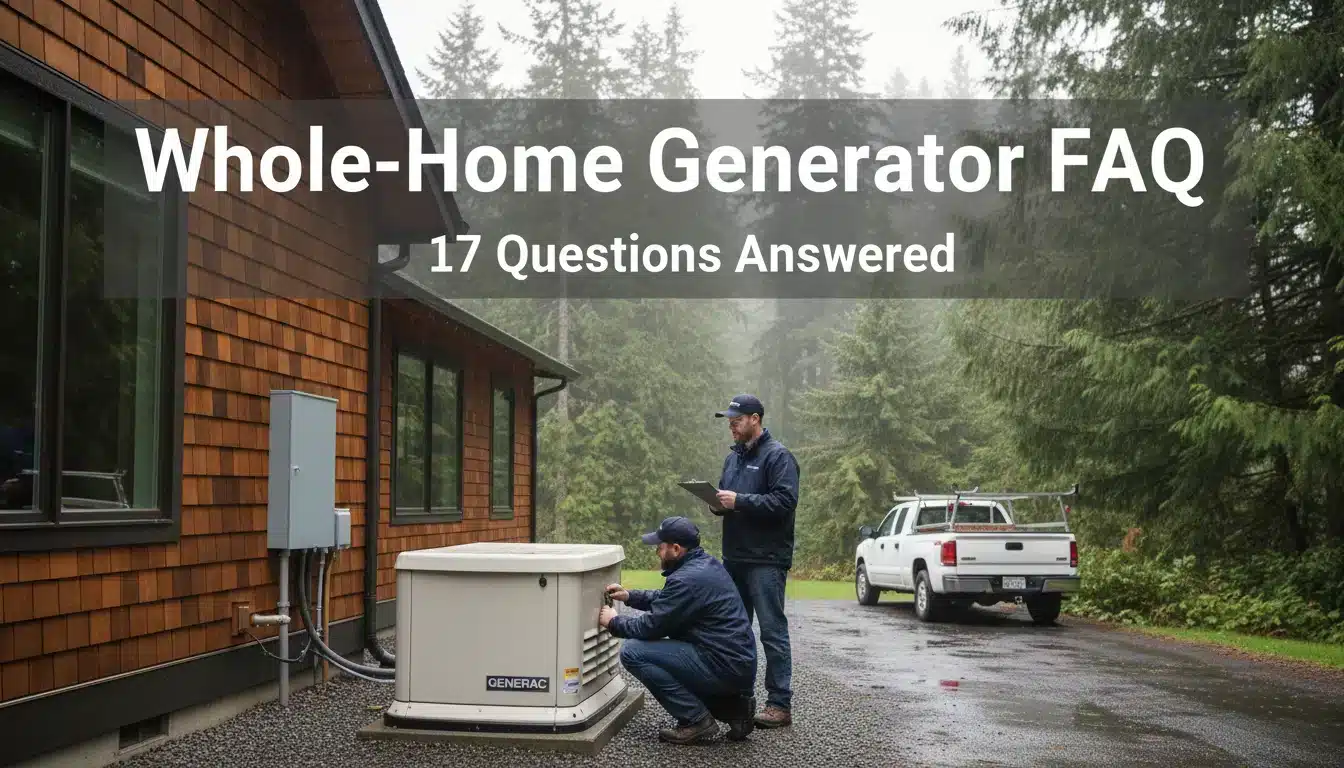
When the power goes out in Snohomish or King County, a whole-home standby generator turns a stressful outage into a non-event. But most homeowners land on the same round of questions before they commit — about sizing, cost, safety, and what actually happens once a windstorm rolls through. Below are the questions we hear most often, answered directly.
Sizing & Choosing the Right System
How do I know what size generator I need?
Sizing depends on which circuits you want to keep powered — a partial-house system covering essentials (refrigerator, sump pump, some lighting, a furnace blower) needs less capacity than a whole-house system built to run everything at once, including central air or an electric range. A proper sizing calculation looks at your electrical panel, your actual appliance load, and whether you’re running gas or electric heat. Two homes of the same square footage can have very different power needs, which is why a real site visit matters more than a generic size chart.
What’s the difference between a portable and a whole-house standby generator?
A portable generator has to be manually set up, fueled, and connected every time the power goes out. A whole-house standby unit is permanently installed outside your home, runs on natural gas or propane instead of gasoline you have to store and refill, and starts automatically within seconds of an outage — whether you’re home or not. The tradeoff is upfront cost: portables are far cheaper to buy, but they require you to be present and manage fuel and placement every single time.
Can I just get a smaller generator and run extension cords to what I need?
This is directly tied to the transfer switch question below. Running a portable generator without a transfer switch means manually deciding what to plug in and unplug, which limits you to a handful of circuits and requires someone present and paying attention every time the power drops.
Installation, Permits & Safety
Why can’t I just plug a generator into an outlet in my house?
This is one of the most important safety questions to get right. Plugging a generator directly into a wall outlet — sometimes called “backfeeding” — can send electricity back through your home’s wiring and out onto utility lines that line crews believe are dead during an outage, putting them at real risk. It can also damage your generator and your home’s electrical system. A properly installed transfer switch prevents this by physically isolating your home’s wiring from the utility grid before the generator can power anything.
Do I need a permit to install a whole-home generator?
Yes. A whole-home standby generator install typically requires an electrical permit, and depending on the fuel source, may also involve gas line work that needs its own permit and inspection. Permitted work gets reviewed by an independent inspector, which protects you at resale and matters if you ever need to file an insurance claim tied to the system.
Is it safe to run a generator during a windstorm?
Whole-home standby generators are installed outdoors in a weatherproof enclosure built for the kind of wind and rain the Pacific Northwest sees regularly, so the weather itself usually isn’t the concern. The real safety issue during storms is almost always with portable generators — running one in a garage, carport, or too close to windows and doors creates a genuine carbon monoxide risk, since CO can build up quickly in a partially enclosed space regardless of conditions outside. Portable generators should only ever run outdoors, well away from doors, windows, and vents.
What fuel does a whole-home generator run on?
Most whole-home standby generators run on natural gas, if your home already has a gas line, or liquid propane stored in a tank on your property. Natural gas gives you an effectively unlimited fuel supply as long as utility gas service is intact, while propane requires monitoring tank levels but doesn’t depend on the gas utility staying up. Which one makes sense depends on what’s already available at your home.
Runtime, Capacity & Maintenance
How long can a whole-home generator run during an extended outage?
A natural-gas-fueled system can run for as long as your gas utility service continues, since it isn’t drawing from an on-site tank that can run dry — a real advantage during a multi-day outage. A propane system’s runtime depends on tank size and your home’s actual power draw, which is part of why correct sizing matters.
Does a standby generator need regular maintenance?
Yes. Like any engine, a standby generator has scheduled maintenance intervals — oil changes, filter checks, battery testing, and a periodic self-test cycle most units run automatically. Skipping maintenance is one of the most common reasons a generator fails to start exactly when it’s needed.
How much does it cost to install a whole-home standby generator?
For a fully installed system in the Snohomish and King County area, homeowners are typically looking at somewhere in the $12,000–$25,000 range, depending on the generator’s size, whether new gas line or panel work is needed, and site-specific installation factors. An accurate quote requires an actual site visit, since the variables that drive cost aren’t visible from a square-footage number alone.
How noisy is a whole-home generator when it’s running?
Modern standby generators run at a level most homeowners compare to a central air conditioning unit or a dishwasher nearby — noticeable if you’re standing next to it, but not disruptive from inside the house with doors and windows closed. Exact noise level varies by generator size and model.
During an Outage
Does the generator turn on automatically, or do I have to start it myself?
A properly installed whole-home system monitors utility power continuously and starts on its own within seconds of an outage — no one needs to be home, and no manual steps are required. This is one of the biggest practical differences from a portable generator, which always requires someone present to set it up.
What happens when utility power comes back on?
The transfer switch detects that utility power has been restored, and after a short delay to confirm it’s stable, automatically switches your home back to grid power and shuts the generator down. You don’t need to do anything.
Will my generator keep my whole house running, including AC and electric heat?
That depends entirely on how the system was sized. A generator sized for your home’s full electrical load — including central air or electric heat — will keep everything running; one sized only for essential circuits will not. This is decided during the initial sizing and installation, which is why an accurate load calculation matters more than picking a generator based on square footage alone.
Choosing an Installer
Does it matter who installs my generator, or can I do it myself?
A whole-home standby generator installation involves electrical panel work, an outdoor gas or propane connection, and a permitted inspection — all work that requires a licensed electrical and often HVAC/gas contractor in Washington State. Beyond the legal requirement, incorrect installation is directly tied to the backfeeding and carbon monoxide risks described above, which is why this isn’t a DIY project.
Is it worth choosing a specific brand, or do they all perform about the same?
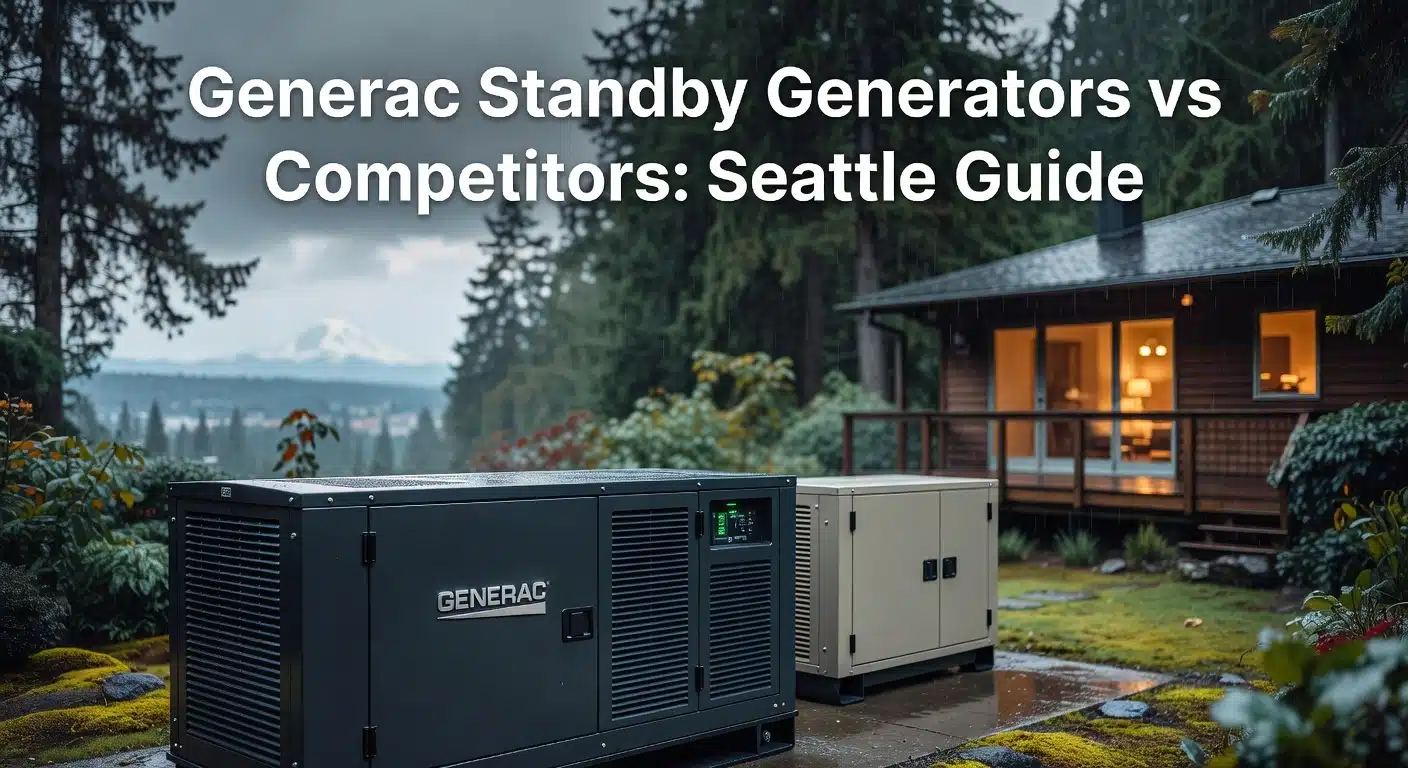
Reliability, parts availability, and local service support vary meaningfully between manufacturers. Mauro Electric is an authorized Generac dealer and installs Generac systems regularly across Snohomish and King County, which means straightforward access to parts and service history specific to that brand — worth asking about when comparing quotes.
How long does installation actually take?
Timeline depends on whether the site already has an accessible gas line and adequate electrical panel capacity, or whether additional work — a new gas line run, a panel upgrade — is needed first. A site visit is the only way to give an accurate timeline, since every property is different.
Every property is different, and the only way to get real numbers on sizing, cost, and installation timeline is a site visit from a licensed team that installs these systems regularly in this area. If you’re weighing a whole-home generator for your Snohomish or King County home, Mauro Electric is happy to walk through what makes sense for your specific setup.