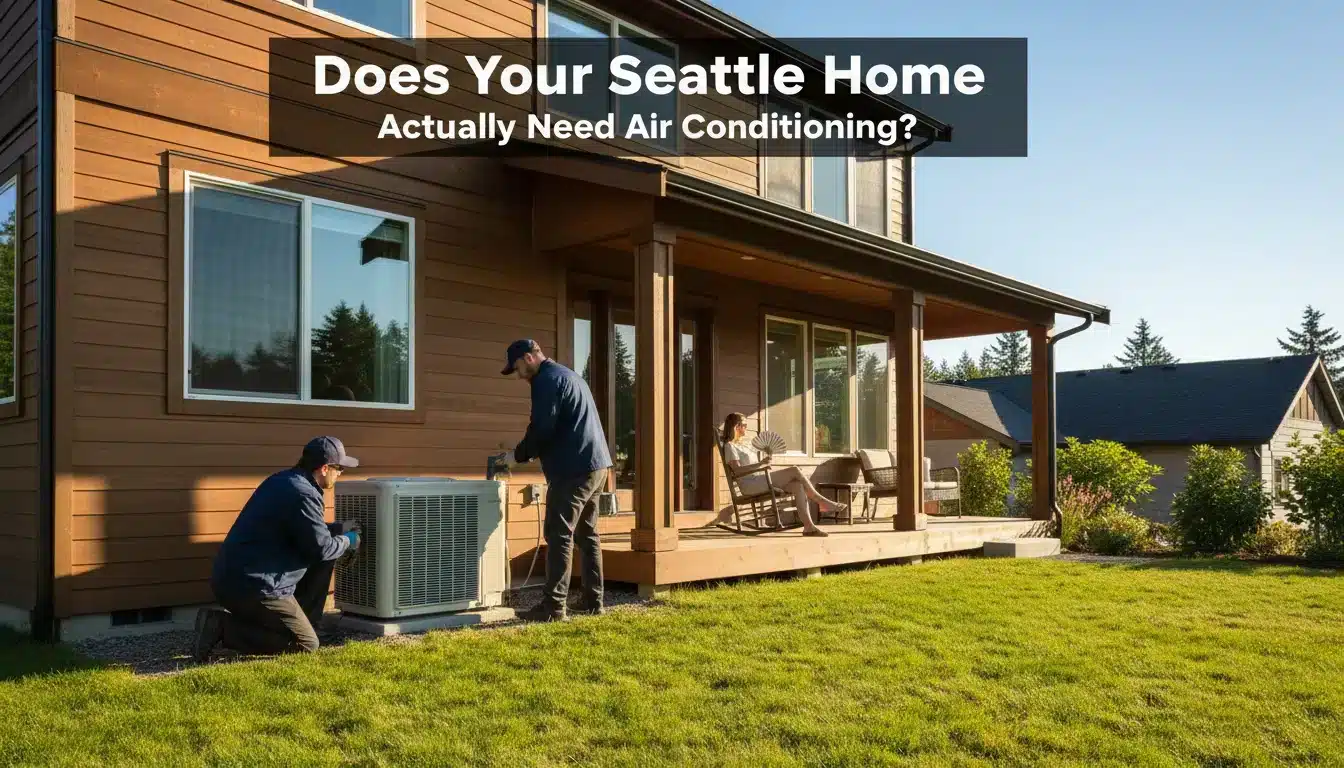
For most of the Puget Sound region’s history, the answer to “do I need AC?” was an easy no. Mild summers, cool nights, and a housing stock built around keeping heat in rather than out meant central air conditioning was something you associated with Phoenix or Houston, not Bothell or Ballard. That’s changed. Seattle spent years holding the title of least air-conditioned major metro area in the country, and it’s only recently started to lose that distinction as more homeowners install cooling.
So is it actually worth it for your home? Here’s how to think it through.
Why This Question Didn’t Used to Matter Here
The numbers tell the story of just how fast this has shifted. Back in 2013, only about 31% of Seattle-area housing units had any form of air conditioning. By 2019 that had climbed to roughly 44%. By 2021, it crossed the halfway mark — around 53% of housing units in the metro area had a primary cooling source. Even with that growth, recent county-level data still shows a large share of homes across our service area without AC, meaning a lot of your neighbors are asking this same question right now, not just you.
The Event That Changed a Lot of Minds
If there’s one moment that shifted how seriously homeowners here take summer heat, it’s the late-June 2021 heat wave. Over three days, June 26 through 28, the region baked under a weather pattern meteorologists call a “heat dome” — a stagnant ridge of high pressure that trapped hot air in place. Seattle hit 108°F on June 28, 2021, the hottest temperature ever officially recorded in the city. The Washington State Department of Health reported 136 heat-related deaths statewide in the window from June 26 through July 6 that year. For a region where most homes were built to hold heat in during long, wet winters, that kind of event exposed a real vulnerability: without any cooling, a home here can turn into an oven with nowhere for the heat to go, especially overnight when temperatures used to reliably drop.
It’s Not Just About Heat Waves Anymore
Wildfire smoke season has also become a fixture of Pacific Northwest summers in recent years. When smoke rolls in, the usual advice of “open the windows at night to cool down” stops being a good option — you’re trading heat for poor air quality. A cooling system that can run with the windows shut, especially one paired with decent filtration, solves both problems at once instead of forcing a choice between them.
What Are Your Real Options?
A lot of homes in our service area — especially older construction throughout Seattle, Bothell, and the surrounding cities — were never built with ductwork for central air. That doesn’t mean central air is your only path forward.
Ductless Mini-Splits
For homes without existing ductwork, a ductless mini-split system is usually the most practical way to add cooling. It doesn’t require tearing into walls and ceilings to run ducts, it can be zoned room by room, and it does double duty as an efficient heating source in the winter. We’ve got a full breakdown of what mini-split installation actually costs in the Seattle area if you want to get into the numbers.
Central Air (If You Already Have Ductwork)
If your home already has a forced-air furnace and ductwork, adding central air conditioning is often more straightforward, since the distribution system is already in place. The main consideration becomes whether your existing ductwork and electrical panel can support the added equipment.
How to Actually Decide
A few honest questions worth asking yourself:
How does your home handle a hot stretch right now? If a few 90-degree days in a row already make your upstairs bedrooms miserable at night, that’s a real comfort problem worth solving, not something to tough out.
Does anyone in the home have health considerations? Extreme heat is genuinely dangerous for older adults, young children, and anyone with respiratory or cardiovascular conditions. That’s not a comfort question, it’s a safety one.
Are you thinking about resale? Buyers in this market increasingly ask about cooling during showings, particularly for anyone who’s lived through a Seattle heat wave without it. It’s becoming less of a nice-to-have and more of an expected feature, especially in homes at higher price points.
What’s your realistic budget and timeline? A ductless system can often be installed in a matter of days once you’re ready to move forward, which matters if you’re trying to get ahead of next summer rather than reacting mid-heat-wave when every contractor in the region is booked solid.