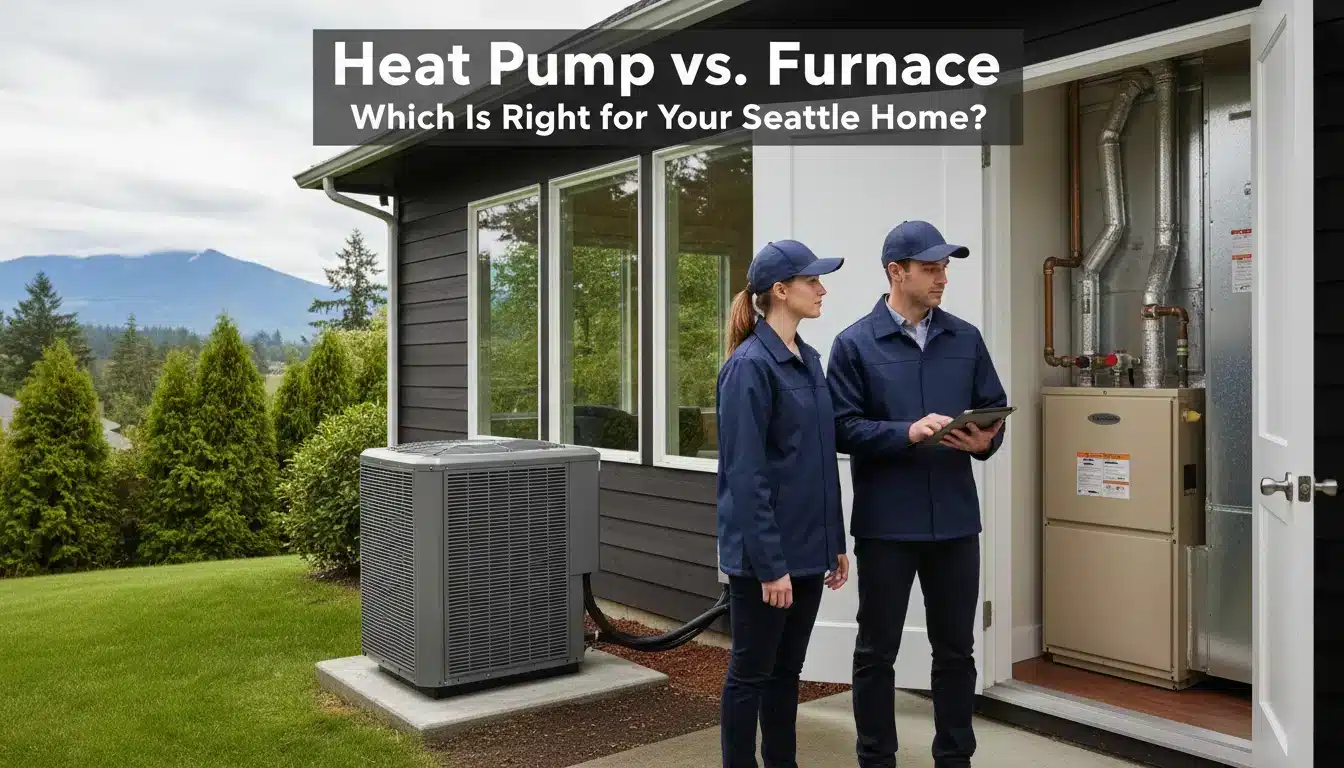
If you’re replacing an aging furnace or building out a new system, you’ve probably landed on the same question most homeowners in our service area eventually ask: heat pump or furnace? It’s not a one-size-fits-all answer, but it’s also not as complicated as it can feel once you know what actually matters for a home in the Puget Sound area.
The Short Version
A gas furnace burns fuel to generate heat directly. A heat pump doesn’t generate heat at all — it moves it, pulling warmth from outside air and concentrating it indoors in winter, then running the process in reverse to cool your home in summer. That’s the biggest practical difference: a heat pump gives you heating and cooling from one system, while a furnace only heats, meaning you’d need a separate AC unit if you want to cool your home too.
The Cold-Weather Question Everyone Asks
This is the concern we hear most often, and it’s a fair one — a lot of people still picture heat pumps as something that struggles once it actually gets cold. That reputation is mostly left over from older technology. Modern cold-climate heat pumps are a different category of equipment.
ENERGY STAR’s Cold Climate certification requires a heat pump to maintain at least 70% of its rated heating capacity at 5°F, and many current cold-climate models hold onto 75-85% of their capacity at that temperature. Some top-tier systems keep producing usable heat well below 5°F, down into negative territory. For context, Puget Sound’s lowland winters rarely push that far — most of our cold snaps stay well above single digits. A properly sized cold-climate heat pump is built to handle conditions far harsher than what a typical Bothell, Everett, or Seattle winter actually delivers.
If you want a middle ground without fully committing to one system, a hybrid (dual-fuel) setup pairs a heat pump with a gas furnace backup — the heat pump handles the vast majority of the season efficiently, and the furnace only kicks in on the rare night it’s genuinely needed. It’s worth asking about if you like the efficiency story but aren’t ready to go fully electric.
Upfront Cost vs. Long-Term Cost
A heat pump system typically costs more to install than a comparable furnace, largely because you’re getting both heating and cooling capability in one piece of equipment instead of two separate systems. Where it evens out — and often comes out ahead — is in monthly operating cost. Because a heat pump moves heat instead of generating it through combustion, it can deliver more heating energy per dollar of electricity than a furnace delivers per dollar of gas, especially at the mild-to-moderate temperatures that make up most of our heating season here.
There are also real incentive programs currently available in our service area that can meaningfully offset the upfront cost difference — we cover those in detail in a separate post, since the rebate landscape has enough moving pieces (utility programs, income-based bonuses, program-specific contractor requirements) to deserve its own explanation. It’s worth asking us about before you assume a heat pump is out of budget.
What Actually Drives the Right Choice
A few honest factors matter more than any general rule:
Do you want air conditioning? If cooling matters to you at all — and more homeowners in our area are deciding it does after recent summers — a heat pump gets you there without a second system.
What’s your home’s electrical capacity? A heat pump install sometimes requires panel work to support the added electrical load, particularly in older homes. This is worth having assessed before you commit to a system, since it affects the real total cost of the project.
How long do you plan to stay in the home? A heat pump’s efficiency advantage compounds over years of lower operating costs, which matters more if you’re not planning to sell soon.
What’s your existing ductwork situation? Both systems typically use the same ducted distribution if you already have it, though ductless mini-split heat pumps are an option worth discussing if your home doesn’t have ducts at all.
There’s No Wrong Answer, Just the Right Fit
A well-maintained gas furnace is still a perfectly reasonable choice for plenty of homes, especially if air conditioning isn’t a priority and your existing gas infrastructure is already in good shape. A heat pump makes the most sense if you want cooling capability, you’re doing a full system replacement anyway, or you want to take advantage of the efficiency and incentive picture that’s currently available. The honest answer depends on your specific home, budget, and priorities — which is exactly what a real system evaluation is for, rather than a generic recommendation.